Configuration Rules
Managing configuration settings individually across multiple monitors can be time-consuming, particularly when you need to assign threshold profiles, update check frequencies, organize monitors into groups, or apply tags.
Configuration Rules help automate these tasks by allowing you to define conditions and corresponding actions. When a monitor matches the specified conditions, configured actions are applied, reducing manual effort and helping maintain consistent monitoring configurations.
You can use Configuration Rules when adding new monitors or apply them to existing monitors. Rules can also be prioritized to control the order in which they are evaluated and prevent conflicting configurations from being applied.
You can apply the same configuration settings across different monitor types by creating separate rules. For example, configure Rule A for Server monitors and create Rule B with identical settings for Network monitors.
Use cases
- Automate configurations for new monitors: Automatically assign threshold profiles, check frequencies, and notification settings to newly added monitors based on predefined criteria.
- Apply location-specific monitoring settings: Identify monitors based on their IP addresses or naming conventions and automatically assign them to the appropriate monitor groups or location profiles.
- Standardize monitoring across environments: Categorize production, staging, and development monitors using naming conventions, and apply environment-specific threshold profiles, tags, and alert settings.
- Manage server services and processes: Automatically associate specific services or processes with matching server monitors to ensure that critical application components are monitored consistently.
- Organize discovered network interfaces: Identify network interfaces based on their attributes and automatically assign relevant configurations, helping manage large numbers of interfaces discovered across network devices.
Supported monitor types
Configuration Rules are supported across all monitor types. You can configure rules for existing monitors or evaluate newly added monitors against previously created rules.
For server monitors, you can also define rules using parameters such as resource checks, services, and processes.
Configuration Rules can also help classify and organize network interfaces discovered across routers, switches, firewalls, wireless LAN controllers (WLCs), and other network devices.
How does Configuration Rules work?
Configuration Rules operate based on predefined criteria and actions.
- Criteria: Define the conditions a monitor must meet for a rule to apply. You can combine multiple criteria using AND or OR.
- Actions: Specify the configuration changes to perform when the criteria are met. A rule can contain multiple actions, such as assigning a threshold profile, updating the check frequency, adding tags, or associating the monitor with a monitor group.
Suppose you want to configure monitors that meet either of the following conditions:
Condition: OR
- Monitor name is Zylker.
- IP address begins with 192.
Actions:
- Set the check frequency to five minutes.
- Add the tag US.
- Associate the monitor with the Server monitor group.
When a monitor matches either criterion, the configuration actions are applied.
If you select AND instead, the actions are applied only when the same monitor matches both criteria.
Understanding AND and OR conditions
- AND: All the specified criteria must match for a monitor to qualify. Use this when you want to apply configurations only to monitors that meet multiple requirements.
- OR: At least one of the specified criteria must match for a monitor to qualify. Use this when you want the same configurations applied to monitors that meet any of the defined conditions.Adding a Configuration Rule
You can associate Configuration Rules while creating a new monitor; alternatively, you can create a rule, and run a scan to see if any of the existing monitors match the configured rules. When you run a scan on existing monitors, their previous configuration settings will be overridden by the new set of rules.
Understanding configuration actions
Configuration Rules support actions such as assigning threshold profiles, changing check frequencies, associating automations, and updating monitor organization settings.
Depending on the configuration attribute, actions may append new values to existing settings or replace the current values.
Append and Replace
For supported multi-value settings, you can control how the rule updates existing monitor configurations.
- Append: Adds the configured values while retaining the existing values.
- Replace: Removes the existing values and applies the values specified in the rule.
The Append and Replace options are documented for monitor groups, tags, third-party services, and user alert groups.
Certain configuration settings, such as threshold profiles, location profiles, and check frequencies, are replaced when the corresponding rule actions are applied.
For services and processes, rule execution appends the configured items without replacing existing ones.
Review the selected action and its available options before executing a rule on existing monitors, as configuration changes may override current settings.
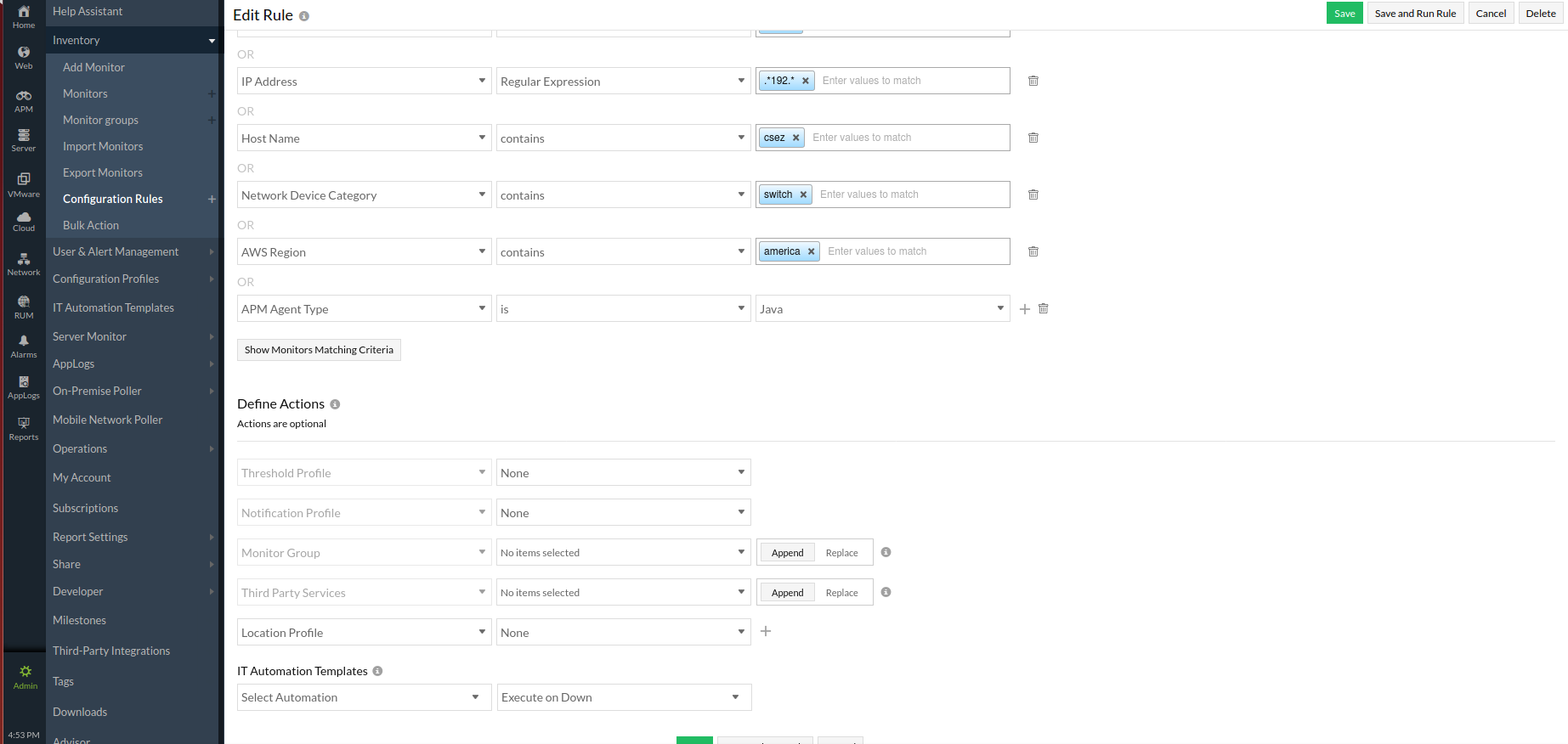
How to create a Configuration Rule
- Log in to your account.
- Navigate to Admin > Inventory > Configuration Rules.
- Click the + icon to create a new rule.
- Configure the following fields:
- Display Name: Enter a name that identifies the rule.
- Description: Provide a brief explanation of the rule's purpose.
- Stop executing other rules: Enable this option if you want to stop evaluating lower-priority rules after the current rule matches.
- Criteria: Select AND or OR, choose the required attributes from the drop-down, and specify their corresponding values. You can add multiple criteria.
- Action: Select the configuration changes to perform when the criteria match. You can configure multiple actions within the same rule.
- Append/Replace: Where supported, choose whether to retain existing configuration values or replace them with the specified values.
- Click Save to create the rule.
- Alternatively, click Save and Run Rule to save the rule and immediately apply it to matching existing monitors.
Running a rule on existing monitors can modify or replace their current configurations based on the selected actions.
How to apply Configuration Rules to newly added monitors
You can evaluate existing Configuration Rules when adding a new monitor.
- Navigate to Admin and select the monitor type you want to add.
- Enter the required monitor details, including its display name.
- Under Configuration Profiles, locate Run through configured rules.
- Set the toggle to Yes to evaluate the monitor against the configured rules.
- Click Save.
When the criteria match and the monitors support the applicable rules, the corresponding actions are performed.
You can also manage the Execute rules during monitor addition option from the Configuration Rules page to control rule evaluation for newly added monitors.
Managing Configuration Rules
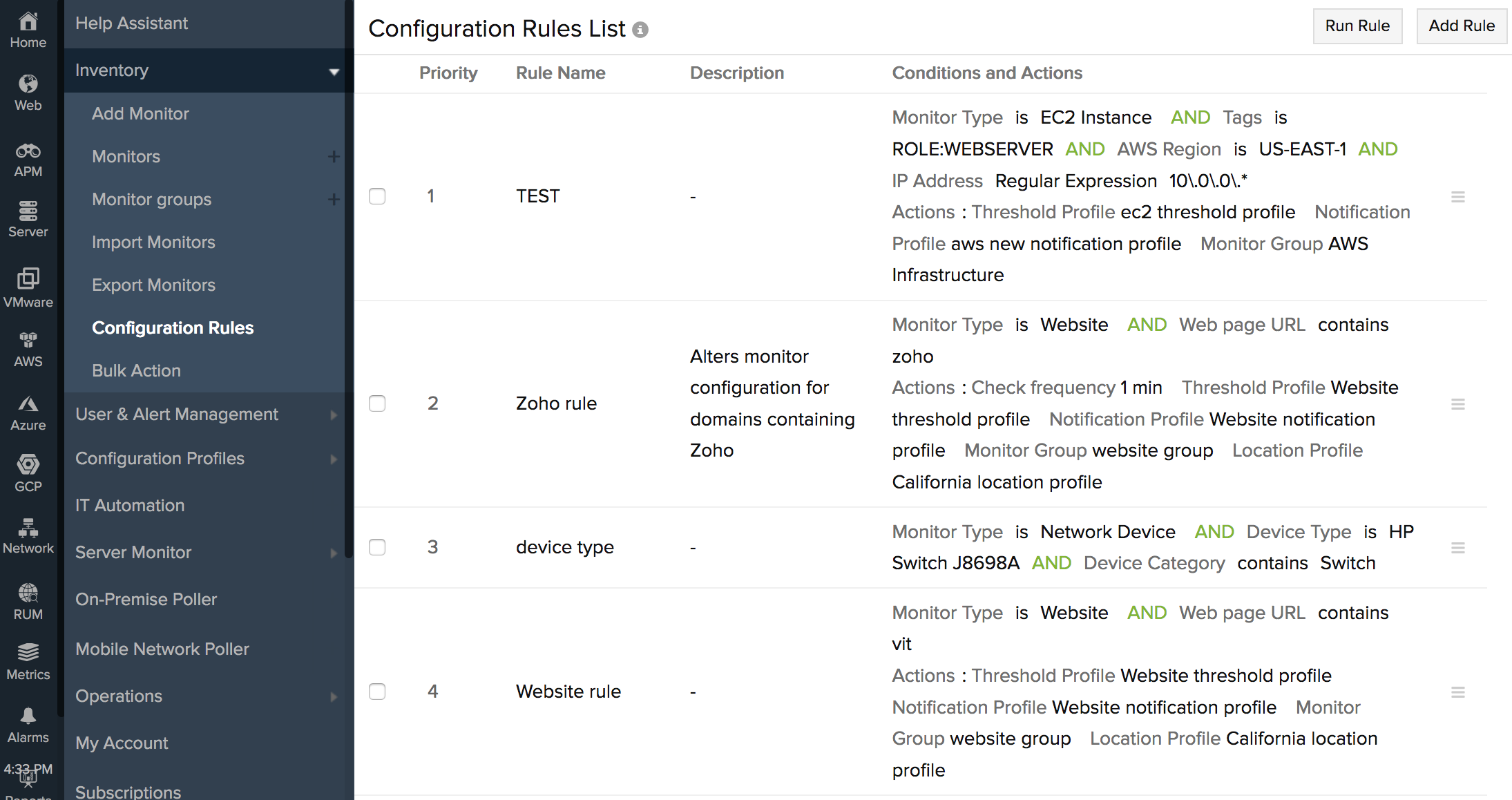
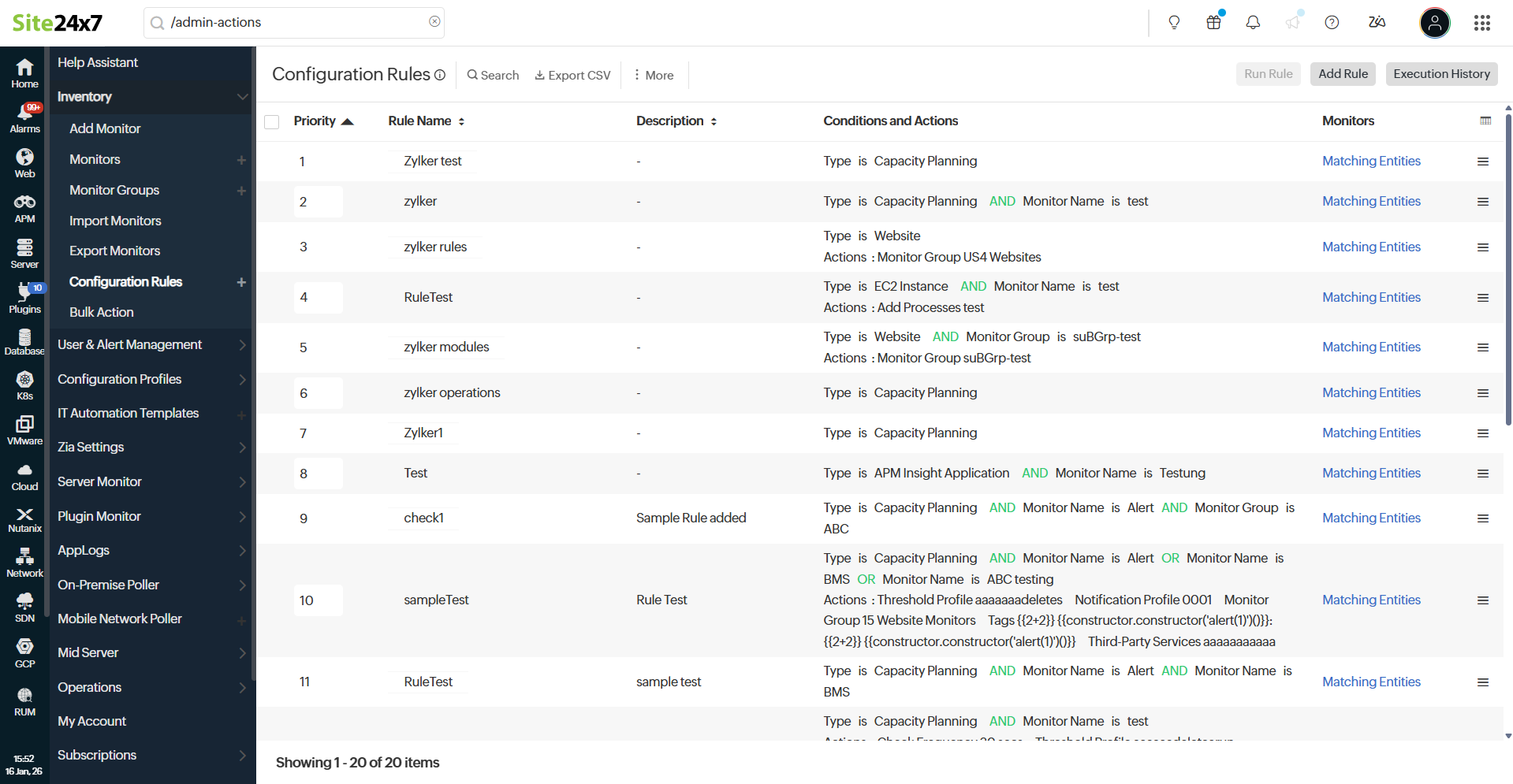
After creating rules, navigate to Admin > Inventory > Configuration Rules to view and manage them.
Set rule priorities
Every Configuration Rule has a priority that determines its evaluation order. Rules with lower priority numbers are evaluated first.
For example, a rule assigned priority 1 is evaluated before a rule assigned priority 2.
When multiple rules match the same monitor, their actions may affect the same configuration settings. You can enable Stop executing other rules to prevent lower-priority rules from being evaluated after a matching rule.
This is particularly useful when rules assign different threshold or notification profiles.
A matching higher-priority rule with Stop executing other rules enabled can prevent lower-priority rules from executing, even if the higher-priority rule has no applicable action for that monitor.
View matching monitors
Use the Matching Monitors option associated with a rule to view monitors that satisfy its defined criteria.
This helps you identify which monitors qualify for the rule before applying configuration changes.
View execution history
The Execution History section displays information about rules whose actions were executed during the last seven days.
You can use this information to review recent rule execution activity.
Clone a Configuration Rule
You can clone an existing rule to create another rule with similar settings.
- Navigate to Admin > Inventory > Configuration Rules.
- Open the menu associated with the rule you want to duplicate.
- Select Clone.
- Modify the configuration as required and save the new rule.
Cloning helps reduce repeated configuration when multiple rules share similar criteria or actions.
How to edit a Configuration Rule
- Navigate to Admin > Inventory > Configuration Rules.
- Select the rule you want to modify.
- Update the required criteria, actions, or other configuration settings.
- Click Save.
Review the rule priority and execution settings after making changes to ensure that the updated rule behaves as intended.
Best practices for configuring rules
- Define specific criteria: Use monitor attributes that clearly identify the resources requiring the configuration changes.
- Choose AND or OR carefully: Use AND for monitors that must meet all conditions and OR when matching any one condition is sufficient.
- Review existing configurations: Check whether an action appends values or replaces current settings before applying rules to existing monitors.
- Prioritize conflicting rules: Assign priorities and use Stop executing other rules when different rules could update the same configuration.
- Verify matching monitors: Review the monitors that meet the rule criteria to confirm the intended scope.
- Review execution history: Check recent executions to understand which rules have been applied.
-
On this page
- Use cases
- Supported monitor types
- How does Configuration Rules work
- Criteria
- Action
- Understanding configuration actions
- How to create a Configuration Rule
- How to apply Configuration Rules to newly added monitors
- Managing Configuration Rules
- How to edit a Configuration Rule
- Best practices for configuring rules