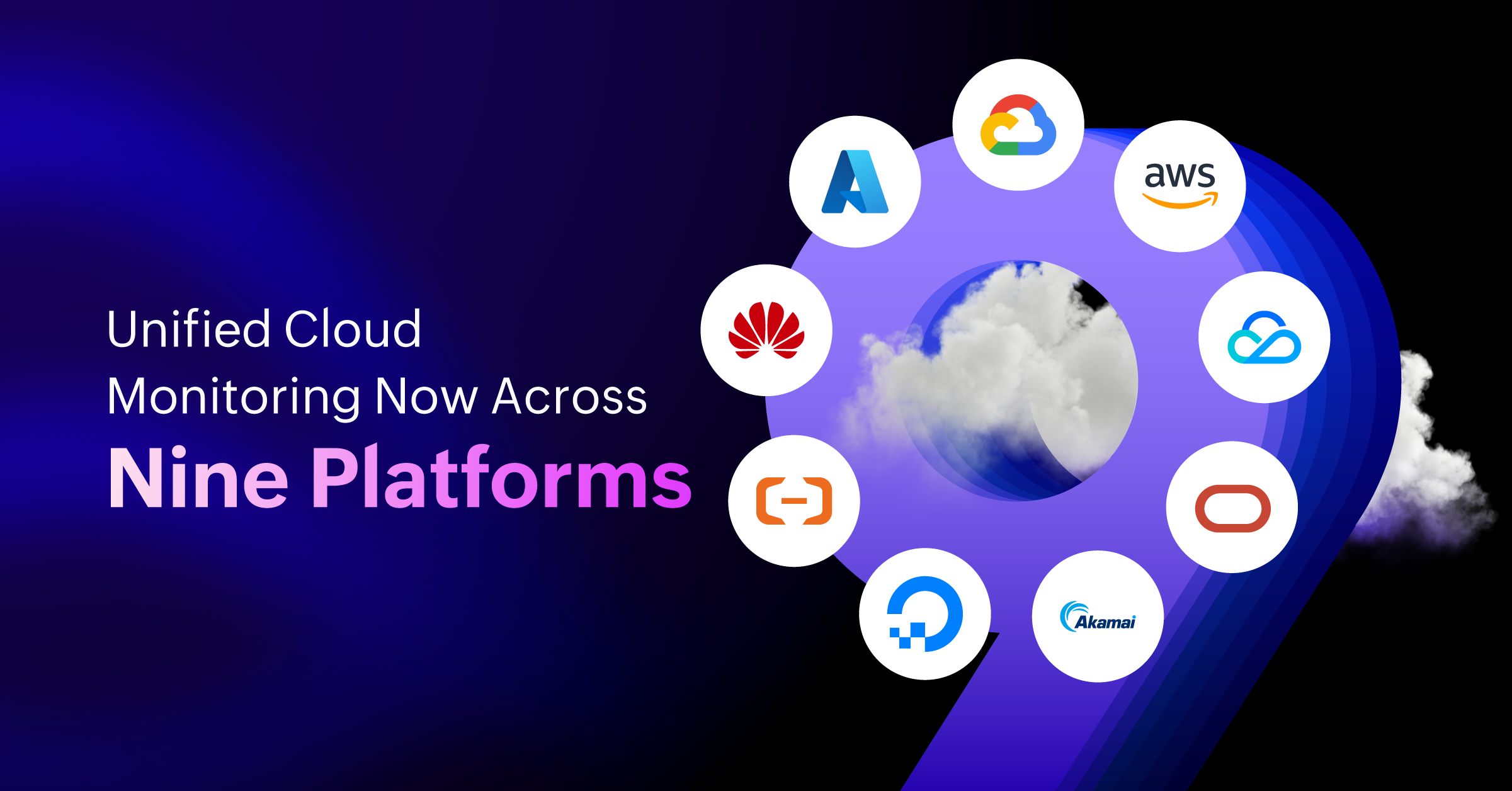
Site24x7 now provides unified visibility across nine cloud platforms—from the hyperscalers to the infrastructure powering regional and edge workloads worldwide.
Most organizations don't run on a single cloud. Whether driven by acquisition, regional compliance, or a deliberate multi-cloud strategy, your infrastructure is scattered—and your observability should match it. Today we're expanding Site24x7 cloud monitoring to cover five additional platforms: Tencent Cloud, Alibaba Cloud, Huawei Cloud, Akamai Cloud (formerly Linode), and DigitalOcean—all visible from the same dashboard you already use.
Existing Platforms
| Microsoft Azure | Amazon Web Services (AWS) | Google Cloud (GCP) | Oracle Cloud Infrastructure |
Newly added
| Alibaba Cloud | Tencent Cloud | Huawei | DigitalOcean | Akamai |
Why this matters for your cloud architecture
APAC and regional coverage Compliance and latency requirements often mandate regional cloud use—now you can monitor them without a separate toolchain. | Edge and developer clouds Akamai Cloud and DigitalOcean power edge compute, developer tooling, and cost-optimized workloads. When blind spots happen here, incidents may go undetected until they affect users. |
All nine clouds surface into the same Site24x7 console with unified alerting, SLA tracking, capacity metrics, and cross-cloud monitoring. |
Inherited infrastructure from acquisitions frequently runs on non-hyperscaler clouds. Now you can bring it under the same observability tool from day one. |
Each newly added cloud provider ships with resource-level monitoring across compute, storage, networking, and managed databases. You also get prebuilt dashboards, threshold-based alerting, and integration with Site24x7's intelligent alerts engine. Performance metrics, and availability tracking work the same way you've come to expect across Azure, GCP, AWS, and OCI.
Your cloud architects shouldn't have to choose between where they deploy and how well they can observe the infrastructure. We're setting the standard on multi-cloud observability, and we're planning to take IT infrastructure observability even further. Stay tuned.