
Network monitoring systems detect and report real-time performance issues, while ITSM platforms handle structured incident management and resolution. When these systems operate independently, alerts may remain unresolved, ownership becomes unclear, and downtime extends unnecessarily.
By integrating network monitoring with ITSM workflows, every alert can automatically convert into a ticket, enriched with device details, severity, and escalation rules. This enables network engineers to reduce the mean time to repair (MTTR), maintain service availability, and enhance overall operational reliability.
Why integrating network monitoring with ITSM tools is critical
Monitoring enables detection; ITSM delivers structured response. Without integration, network incidents are handled inconsistently. Common operational challenges include:
- Isolated alerting systems: Network alerts don’t always create ITSM tickets automatically.
- Manual effort: Engineers reenter the same alert data into service tools.
- Limited visibility: ITSM agents lack access to live performance data from network monitors.
- Unclear ownership: Alerts may be missed, duplicated, or delayed across teams.
Integrating monitoring with ITSM streamlines event flow from detection to closure, ensuring that network visibility translates into a structured response.
How integrated monitoring improves network performance management
When integrated effectively, network monitoring and ITSM systems allow network operations teams to maintain high availability and service continuity.
Integrating Site24x7 with your ITSM solution offers:
- Automated ticket generation: Network alerts instantly create ITSM incidents.
- Two-way synchronization: Tickets close automatically when devices recover.
- Unified visibility: Performance metrics such as latency, jitter, and bandwidth utilization are accessible within ITSM dashboards.
- Cross-team collaboration: NOC and service management teams share unified context on the same incidents.
This coordination allows engineers to focus on service-impacting incidents instead of manually triaging isolated alerts.
Supported third-party ITSM tools and integrations in Site24x7
Site24x7 integrates with a wide range of third-party platforms, enabling automated incident management and real-time visibility across hybrid environments.
Natively supported ITSM and collaboration platforms include:
- ServiceNow: Supports CI association and service mapping for CMDB alignment
- Freshservice: Enables bidirectional ticket synchronization
- Jira Service Management: Supports ticket creation and updates through APIs
- ManageEngine ServiceDesk Plus: Seamless alert-to-ticket workflow integration
- Opsgenie and PagerDuty: On-call routing and escalation management.
- Microsoft Teams and Slack: ChatOps integration for instant collaboration and alert acknowledgment.
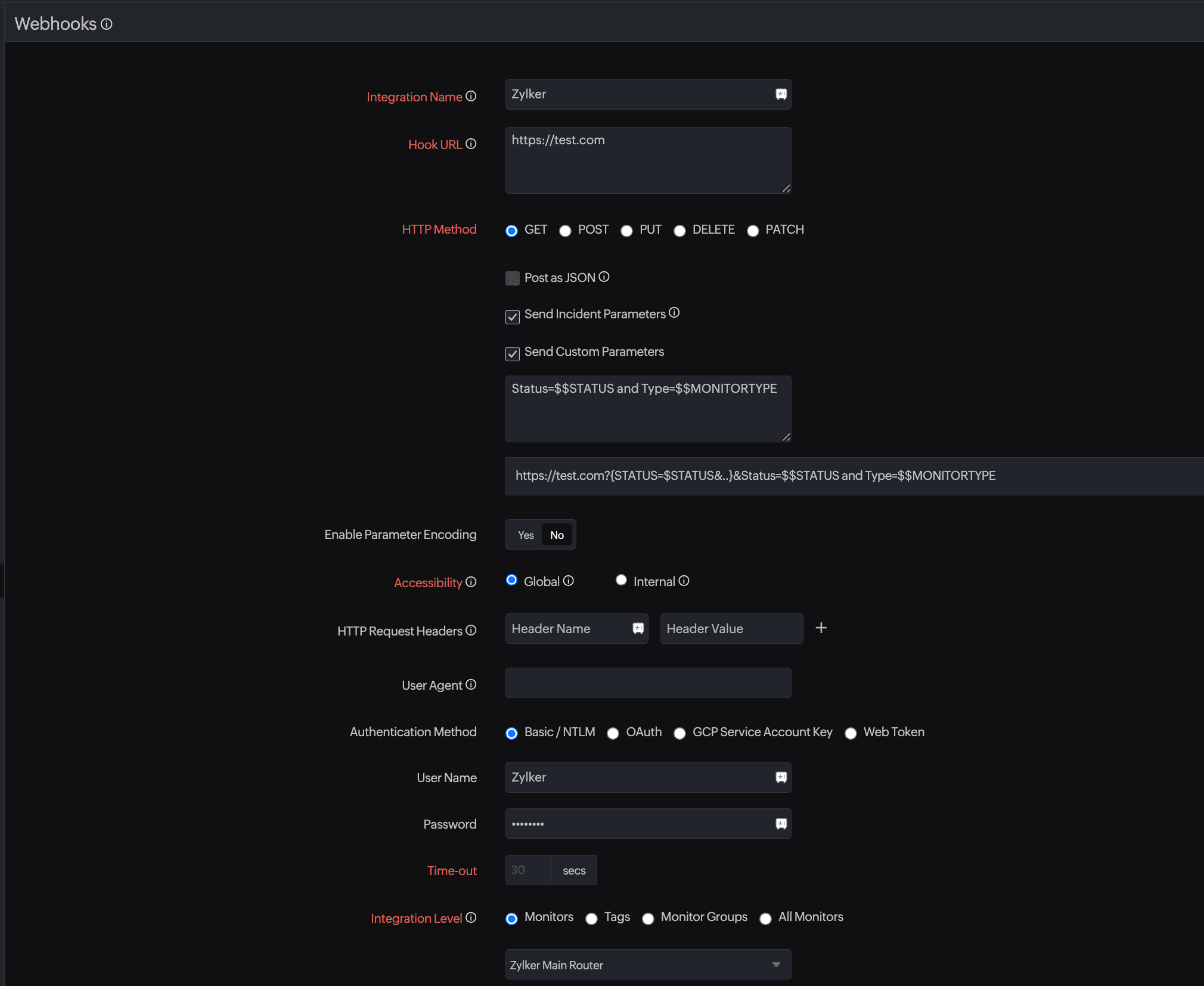
Additionally, organizations can integrate any REST API-based ITSM ticket automation system using custom webhooks and JSON payload templates.
Full integration setup instructions are available in the Site24x7 Third-Party Integrations guide.

Step-by-step guide to integrating Site24x7 with ITSM platforms
- Identify critical devices and metrics
- Focus on high-impact network components such as routers, WAN links, and VPN gateways.
- Configure thresholds for availability, packet loss, and latency.
- Set up Site24x7 monitoring
- Enable performance and traffic monitoring alongside configuration management.
- Track metrics like bandwidth utilization, jitter, and error rates.
- Configure ITSM integration
- Go to Admin > Third-Party Integrations in Site24x7.
- Choose your ITSM platform and authenticate using API keys or instance URLs.
- Send a test alert to confirm connectivity.
- Map escalation rules
- Align Site24x7 alert severity levels (Critical, Trouble, Down) with ITSM ticket priorities (P1–P4).
- Assign responsibilities to the right teams and regions.
- Correlate network performance with incident trends
- Include device name, IP, and metric values in tickets for deeper visibility.
- Use dashboards to track the relationship between performance degradation and incident spikes.
- Perform periodic reviews
- Assess the accuracy and volume of created tickets.
- Adjust thresholds and API keys as needed after updates to either platform.
Technical analysis of Site24x7-ITSM integration
From an engineering standpoint, Site24x7 provides a modular, secure, and scalable integration framework for network monitoring and ITSM workflows. It supports both cloud-based and on-premises setups, making it suitable for diverse network architectures.
- Extensive API coverage: Enables both native and custom integrations through RESTful APIs and webhooks.
- Bidirectional updates: Alerts automatically sync with ITSM tickets to maintain data consistency.
- Tag- and group-based alert control: Allows selective incident creation by network segment or business service.
- Distributed monitoring support: Probes ensure integration continuity in hybrid networks.
- Secure authentication: HTTPS and API key-based connections
ensure encrypted, auditable data exchange.
Platform capabilities and integration flexibility
Site24x7’s design allows deep customization and alignment with enterprise ITSM workflows.
- Service-aware CMDB alignment: In ServiceNow, alerts map directly to configuration items (CIs) for business context.
- Custom extensibility: JSON templates allow integration with proprietary ITSM tools without code-level changes.
- Alert optimization: Tag filters and dependency-aware rules prevent redundant incidents.
- Cross-team visibility: Collaboration tool integration enables quick triage and acknowledgment.
- Data enrichment: Alerts can include interface utilization, last response time, and device details.
- Flexible licensing: Integration and webhook customization options are available across pricing tiers.
Example use case
A network admin can configure Site24x7 to automatically generate a P1 ticket in ServiceNow when WAN latency exceeds 300 ms for over two polling cycles. When the metric normalizes, the ticket closes automatically, maintaining SLA compliance.

Technical robustness and operational reliability
Architectural reliability
The API-driven design minimizes dependency on middleware, making integrations lightweight and fault-tolerant. Bidirectional synchronization ensures consistent status updates between systems.
Performance and scalability
On-Premise Pollers can process thousands of alerts per polling cycle, ensuring consistent performance in distributed environments. Integrations remain responsive even under high alert loads.
Security and compliance
All data exchanges use encryption and authentication. API keys can be regenerated or revoked at any time, and Site24x7 logs integration events for auditing.
Operational efficiency
By connecting network monitoring with ITSM, Site24x7 eliminates repetitive tasks. Engineers gain real-time insights within the same ticket view, and alert storms are mitigated using tag-based rules.
Site24x7 integration strengths and differentiators
Site24x7 offers one of the most flexible ITSM integration ecosystems in its category:
- Broad support for ITSM, collaboration, and AI platforms.
- Custom webhook and JSON extensibility for internal or third-party systems.
- Contextual data enrichment in every ticket to reduce investigation time.
- CMDB alignment for ServiceNow and ServiceDesk Plus users, connecting network events to business services.
- Secure, API-based connectivity ensuring reliability across distributed environments.
These capabilities make Site24x7 a robust platform for IT and network teams looking to unify monitoring, alert management, and service delivery under a single framework.

Strengthening network operations through integrated workflows
Integrating Site24x7 with ITSM and AI tools enables network engineers to shift from reactive troubleshooting to proactive, insight-driven operations. With automated alert handling, contextual intelligence, and secure data exchange, teams can resolve issues faster while maintaining compliance and operational stability.
This alignment between network monitoring, ITSM, and AI workflows delivers shorter MTTR, improved SLA adherence, and a more resilient infrastructure for digital operations.