






What does Site24x7's ISP monitoring tool track?
Site24x7 continuously monitors how ISPs and transit providers handle your traffic. Every data point—from hop-level latency to route changes—is collected, visualized, and alertable so you can act before users complain.
Identify high-latency paths across your ISP network
Run traceroutes from 130+ monitoring locations worldwide and compare latency across every network path. Site24x7 highlights exactly which hop or interface introduces the most delay, so you can isolate ISP-related bottlenecks from infrastructure issues. A global latency heat map gives you an at-a-glance view of connection quality across all your monitored regions.
Verify ISP SLA compliance and manage vendor performance
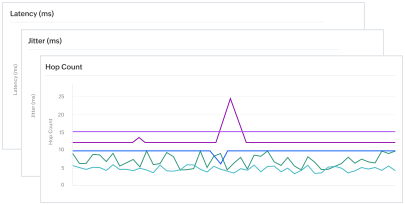
Collect continuous measurements of availability, round-trip latency, hop count, AS number, and jitter for every network path. Compare these metrics side by side against each ISP's committed SLA thresholds—turning raw monitoring data into a vendor scorecard that quantifies which providers deliver and which consistently fall short. Site24x7 also detects uninformed route changes and transit provider switches, giving you immediate visibility into network path alterations that could affect performance. When it's time to renegotiate contracts or evaluate alternative providers, historical SLA compliance data gives your network and procurement teams the leverage they need.
Analyze hop-to-hop data transfer in detail
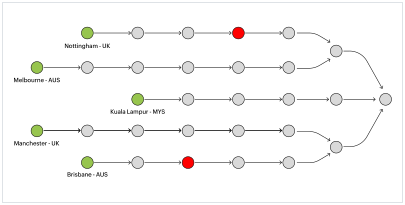
See exactly how your data moves through each network node in both the outbound and return directions of every round-trip measurement. Site24x7's hop-to-hop view reveals latency, connectivity provider changes, IP prefix details, AS number, and AS name at every point along the route. When checked from different vantage points, you can spot asymmetric routing, identify broken links, and determine whether a specific ISP or transit provider is the source of degradation. Search for specific nodes, highlight individual paths, and filter by link delay threshold to focus on the hops that matter most.
Monitor ISP connectivity across ICMP, TCP, and UDP protocols
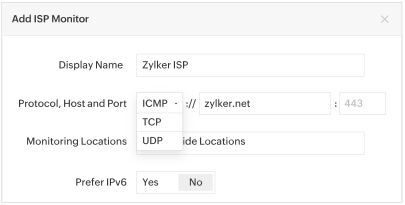
Test domain reachability using all three major transport protocols. Internet Control Message Protocol (ICMP) gives you basic connectivity and round-trip time data, Transmission Control Protocol (TCP) validates application-layer reachability on specific ports, and User Datagram Protocol (UDP) helps you assess performance for latency-sensitive services like VoIP and video streaming. Select the protocol, specify the host and port, and start monitoring in seconds.
Set granular thresholds and alerts at each hop
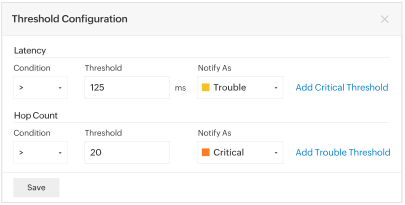
Define threshold limits for every metric you track—latency, jitter, AS number on the traceroute, and the AS number of the last hop. If an untrusted ISP or transit provider begins handling your traffic at any point along the route, you receive an instant alert so you can take corrective action. Thresholds can be configured globally or customized per monitoring location to match regional SLA requirements.
Get proactive alerts for ISP outages and degradation
Site24x7 notifies you the moment ISP performance crosses your defined thresholds. Alerts are delivered through email, SMS, voice calls, or integrations with tools like Slack, Microsoft Teams, PagerDuty, and ServiceNow. With root cause analysis built into every alert, your team spends less time diagnosing and more time resolving. When escalation is necessary, share timestamped traceroute data and performance reports directly with your ISP's support team—providing the concrete, third-party evidence that transforms a vague complaint into an actionable ticket and accelerates resolution.
Gain broad visibility into ISP health across regions
Individual traceroutes show you one path at one moment. Site24x7's multi-location ISP monitoring aggregates traceroute data from 130+ locations continuously, revealing patterns that point-in-time checks miss—regional outages forming across an ISP's backbone, transit congestion building during peak hours, or a provider's performance gradually degrading in a specific geography. This macro-level visibility helps you anticipate problems before they reach your users and correlate ISP health trends with application performance data from your APM stack.