
Site24x7 unifies observability by integrating a wide array of IT operations tools with monitoring. Supporting over 100 integrations across communication, ITSM, workflow, and analytics platforms, Site24x7 converges and consolidates telemetry data from cloud environments, servers, networks, apps, and websites into a single view. By removing silos, enhancing workflows, and providing AI-driven insights and intelligent automation, Site24x7 boosts operational efficiency and enables proactive issue resolution. The modern observability platform’s adaptability with custom scripts ensures scalability, empowering organizations to make data-driven decisions and maintain business continuity.
Legacy monitoring setups, often pieced together over time, can lead to tool sprawl, data silos, and inefficiencies. Site24x7 addresses these challenges by working harmoniously with your current toolkit to take your monitoring game from a piecemeal approach to a continuous stream of consciousness to make informed decisions. Site24x7 brings an integrated approach to your IT operations to make it function as one cohesive ecosystem. Site24x7 consolidates data by closing all visibility and accessibility gaps to transition your organization from fragmented monitoring to unified observability for proactive decision-making.
Why fragmented toolsets fall short
- Incompatibility: Disconnected tools struggle to integrate, leaving visibility gaps and demanding manual effort.
- Redundancy: Overlapping functions across tools create waste and confusion.
- Silos: Isolated data prevents holistic analysis across your IT stack.
- Alert storms: Uncoordinated notifications overwhelm teams, risking missed critical alerts.
- Scalability: Disparate solutions implemented in haste can deepen complexity.
Site24x7: Bridging and enhancing your toolkit
Site24x7 integrates with your existing ecosystem to amplify its capabilities while setting the stage for unified, full-stack observability. With over 100 out-of-the-box integrations, such as MySQL, Apache, Nagios, and Kafka, and support for custom scripts in Python, Shell, PowerShell, and more, Site24x7 ensures comprehensive coverage tailored to your needs.
- Centralized visibility:: Unify telemetry data from the cloud, servers, networks, apps, and websites into a single view, closing visibility gaps.
- Complementary monitoring: Extend coverage to modern environments (e.g., containers and hybrid clouds) without disrupting workflows.
- Third-party sync:: Integrate with tools like Slack, ServiceNow, PagerDuty, and Microsoft Teams for seamless alert routing and collaboration.
- Plugin flexibility: Uncoordinated notifications overwhelm teams, risking missed critical alerts.
- AI-powered insights: Disparate solutions implemented in haste can deepen complexity.
- Integrate legacy tools: Disparate solutions implemented in haste can deepen complexity.
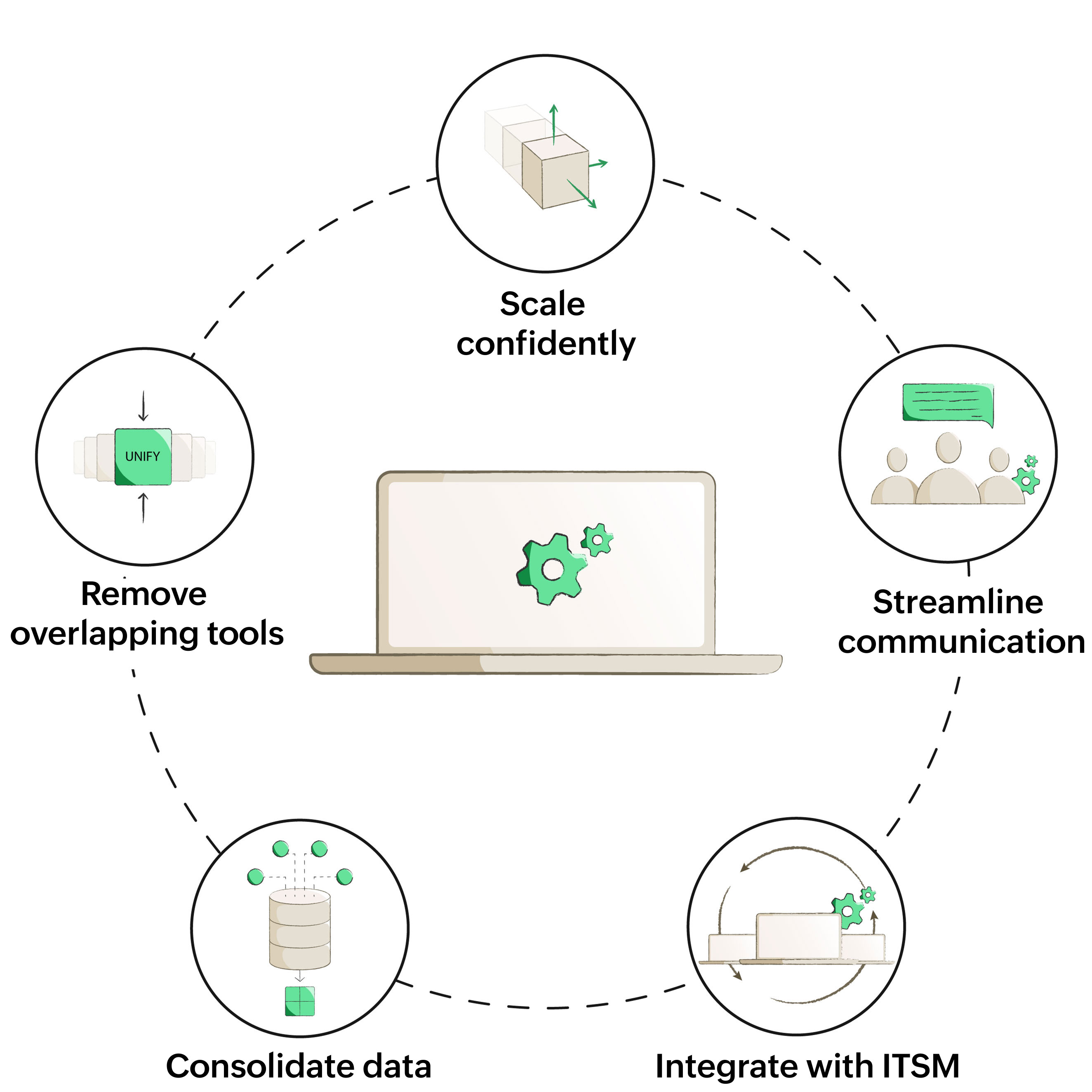
Move towards unified observability
Start anywhere by integrating Site24x7 with your toolkit and gradually move toward consolidated observability.
- Streamline communication: Be alerted via collaboration tools of your choice, like Slack and Microsoft Teams.
- Integrate with ITSM: Sync with tickets from tools like Jira to streamline incident response.
- Scale confidently: Leverage integrations with AWS, Azure, GCP, and DevOps tools to adapt as your needs grow.
- Consolidate data: Derive deeper insights by pairing your data with analytics platforms like ManageEngine Analytics Plus.
- Remove overlapping tools: Eliminate redundancies and consolidate your toolset with Site24x7.
Beginning your integration journey: Some practical tips
- Leverage plugins: Use Site24x7’s plugin repository on GitHub to find all integrations that fit your needs.
- Test and validate: Ensure smooth coexistence by testing integrations with your existing systems.
- Automate alerts: Use AI to refine notifications across tools, cutting fatigue and speeding up resolution.
- Plan consolidation: Assess tool performance regularly to unify under Site24x7’s platform.
Why choose Site24x7?
With extensive, constantly updated integrations; AI-driven analytics; and a plugin ecosystem that covers everything across databases, web servers, cloud platforms, and beyond, Site24x7 unifies your observability by helping you move away from handling fragmented monitoring tools. With Site24x7, you can monitor websites, application performance, servers, networks, and more and collaborate with tools of your choice while staying grounded with actionable insights presented on centralized dashboards.
Take the first step today: Integrate Site24x7 with your toolset and begin enjoying a unified, resilient IT observability platform.
Start 30-day free trial Try now, sign up in 30 secondsFAQs
What integrations does Site24x7 support for unified observability?
Site24x7 supports a wide range of integrations to unify observability. It provides native cloud integrations for AWS (100+ services), Azure, GCP, and OCI. For application monitoring, it supports APM Insight agents for Java, .NET, Python, Node.js, Ruby, PHP, and Go, plus OpenTelemetry integration for open-standards instrumentation. The plugin ecosystem covers databases (MySQL, PostgreSQL, MongoDB, Redis, and more), web servers, and custom applications. Third-party alerting integrations include Slack, Microsoft Teams, PagerDuty, ServiceDesk Plus, Jira, OpsGenie, and many others. StatsD and Prometheus metrics can be ingested natively. This extensive integration coverage helps consolidate fragmented monitoring tools into a single observability platform.
How does Site24x7 unify metrics, logs, and traces in one platform?
Site24x7 converges all three pillars of observability — metrics, logs, and traces — into a single console. Infrastructure metrics are collected via the Full-Stack Agent and On-Premise Poller, application traces through APM Insight agents or OpenTelemetry, and logs through log management with support for system logs, application logs, and cloud logs (such as AWS CloudWatch Logs). Custom dashboards combine widgets from all telemetry types into unified views. Universal mapping visualizes all activities across applications and infrastructure in a single location. Event correlation through Problems links related events across metrics, traces, and logs to identify root causes, providing the contextual analysis needed for effective troubleshooting.
Can Site24x7 integrate with existing DevOps tools and workflows?
Yes. Site24x7 integrates with popular DevOps and collaboration tools to fit into existing workflows. Alerting integrations send notifications to Slack, Microsoft Teams, PagerDuty, OpsGenie, VictorOps, and webhook-based tools. IT automation actions can be triggered automatically when thresholds are breached, enabling self-healing workflows. Site24x7 provides REST APIs for programmatic access to monitoring data and configuration. The milestone marker feature in APM lets you annotate deployments to correlate performance changes with code releases. ChatOps integrations and the Zia assistant provide AI-driven insights directly in your communication channels, enabling faster incident response without switching between tools.