
Content Delivery Networks (CDNs) distribute content across geographically dispersed edge servers to minimize latency and improve user experiences. Regional performance disparities can undermine even the most robust content delivery strategies, causing user frustration and revenue loss despite seemingly healthy CDN metrics. While CDNs promise global performance optimization, real-world delivery often reveals geographic blind spots, origin server bottlenecks, and configuration mismatches that surface only through comprehensive reporting analysis. Learn how to leverage CDN-specific reports within ManageEngine Site24x7's monitoring platform to identify and resolve regional performance issues. Combine synthetic monitoring, Real User Monitoring (RUM), and diagnostic insights to ensure consistent content delivery worldwide.
Role of CDNs in global content delivery
By caching static assets such as images, stylesheets, and videos at Points of Presence (PoPs) strategically located near users, CDNs reduce the distance data must travel and decrease origin server load. Modern CDNs employ intelligent routing algorithms that consider server load, network congestion, and historical performance data to optimize content delivery. Optimization directly impacts business outcomes: A 2020 Deloitte study analyzed several European and US brands and found that decreasing loading time by even 0.1 seconds can boost conversion rates by about 10%. This also implies that a subsequent increase in latency dents conversion rates by an equal measure or more, and is crucial for sectors like e-commerce. Downtime or slow performance in key markets can also erode customer trust, trigger SLA penalties, and diminish SEO rankings, making robust CDN performance a critical driver of profitability and brand reputation.
On the other hand, CDN performance varies significantly across regions due to infrastructure limitations, peering agreements, and local network conditions. Research reveals that geographic proximity does not guarantee better performance. For instance, studies show substantial IPv6 latency penalties in Asia-Pacific regions, with some CDNs experiencing about two to three times higher latency than IPv4. These regional disparities can create performance bottlenecks that traditional monitoring approaches often miss.
Accessing and interpreting CDN reports
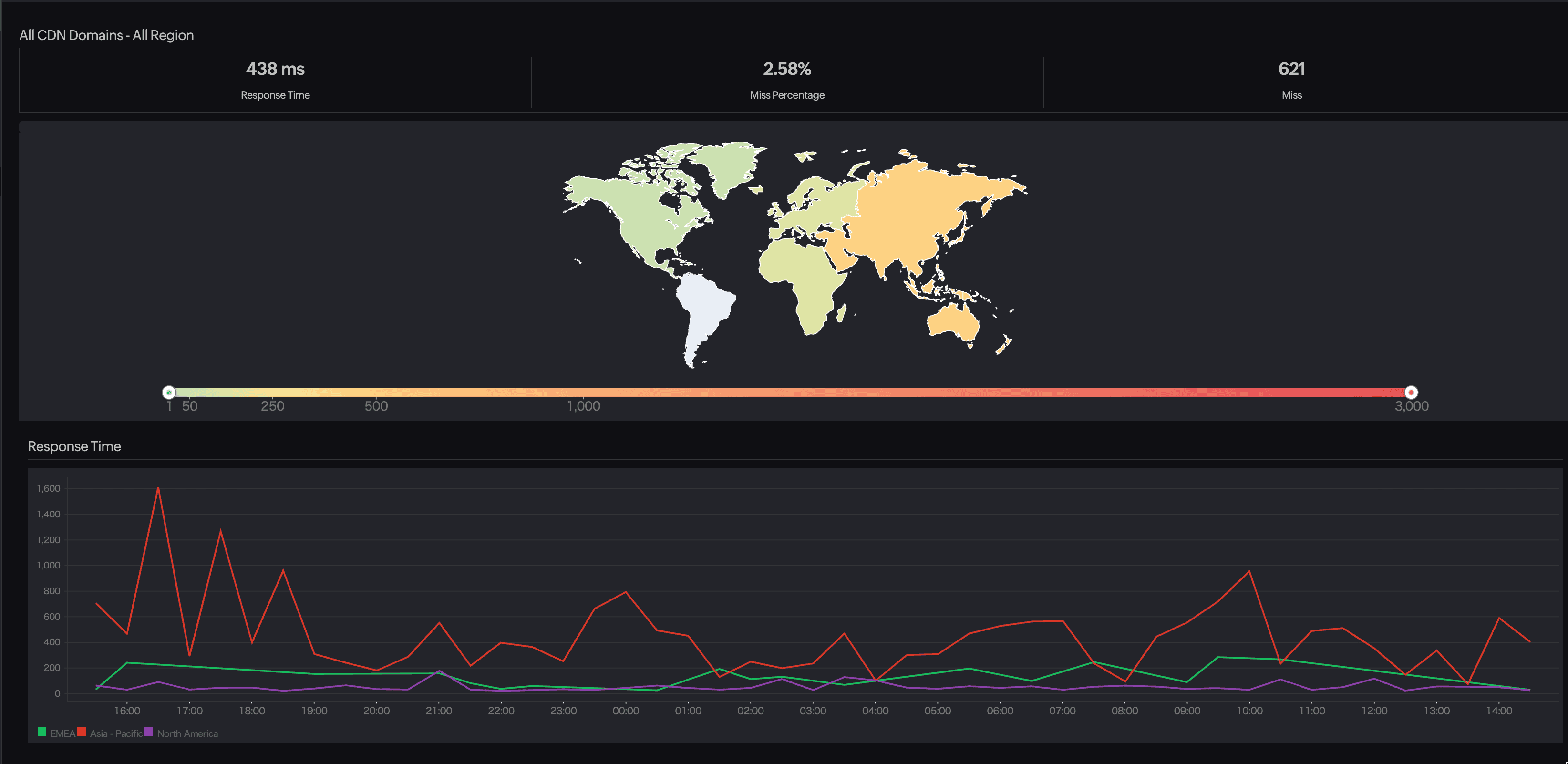
Effective CDN debugging begins with comprehensive log analysis and performance reporting. CDN logs provide detailed records of content requests, cache hit ratios, response times, and error patterns, serving as the foundation for troubleshooting regional issues. Key metrics to examine include cache hit ratios (indicating caching effectiveness), response times by region (revealing geographic performance patterns), and error rates per location (identifying problem areas). Real-time monitoring dashboards display critical performance indicators such as latency, throughput, and availability across different PoPs. These dashboards should segment data by geographic regions, ISP networks, and device types to reveal location-specific bottlenecks. Modern CDN analytics platforms provide heat maps showing performance variations across regions, making it easier to identify underperforming areas.
With Site24x7, access CDN performance insights from your dashboard to get granular metrics such as regional latency and cache efficiency. Site24x7 CDN reports work with webpage speed (browser) monitors by leveraging headers like X-Cache and cf-cache-status to deliver data on cache hit ratios, response times, and miss percentages These insights highlight regional performance variations.Users can also access location-based data with graphical representations, including average response times and miss rates, alongside domain summaries of DNS times, throughput, and hit/miss distributions. You can also view average response time for CDN edge servers, location summaries for city-level granularity, and comparisons of CDN versus origin server performance metrics like SSL Handshake Time and First Byte Time. Furthermore, our Top N reports refine analysis by identifying frequently missed resources, large resources, slow-loading domains, and resources with low TTL. Top N reports can be used to optimize websites, improving loading time and performance across geographical locations.
Identifying bottlenecks beyond surface-level metrics
Even when CDNs appear to function normally at the aggregate level, regional performance issues can persist due to several factors. Origin server limitations become apparent when specific regions consistently experience longer response times despite healthy edge server metrics. This often indicates insufficient origin capacity to handle cache misses from particular geographic areas during peak traffic periods.
Network peering problems manifest as routing inefficiencies where traffic takes suboptimal paths between CDN edge servers and local ISPs. These issues appear in traceroute data showing excessive hop counts or unexpected routing through distant geographic regions. Cache configuration mismatches can cause certain regions to experience higher miss rates, forcing more requests back to origin servers.
Device and browser-specific issues may affect particular regions disproportionately due to local preferences for specific platforms. For instance, regions with a larger proportion of mobile phone users might experience different performance characteristics due to adaptive bitrate streaming requirements or varying network conditions.
Site24x7 enhances bottleneck identification with its Traceroute and MTR (My Traceroute) tools that visualize ISP and peering boundaries, revealing hop-by-hop latency to spot CDN-related delays across ISPs. For example, a traceroute can spot a 200ms delay at a particular ISP peering point in Europe, triggering further investigation. When integrated with CDN reports, Site24x7’s AIOps identifies patterns, such as cache misses to correlate with regional traffic spikes, enabling precise troubleshooting.
Adjusting CDN configurations for regional optimization
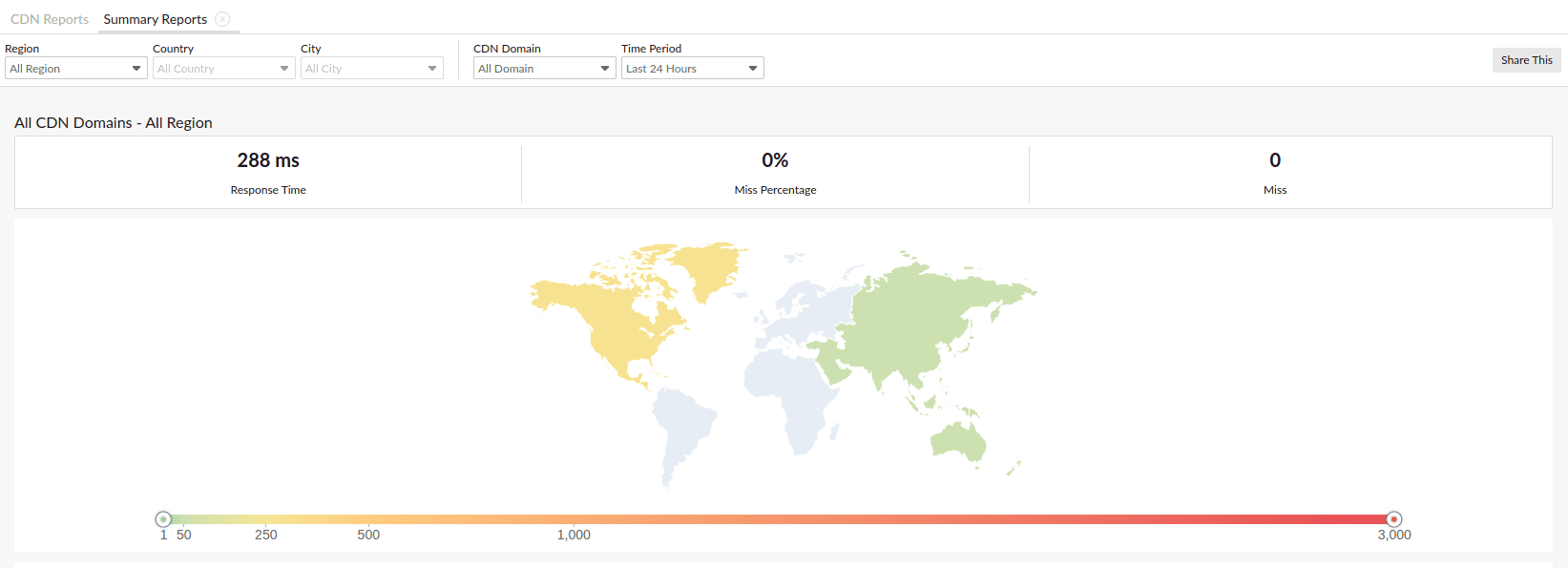
Based on regional content consumption patterns, cache configuration optimization adjusts Time-To-Live (TTL) values. High-traffic regions may benefit from longer cache duration for static assets, while areas with rapidly changing content requirements need shorter TTLs. Purging strategies should account for regional content updates, ensuring stale content does not persist in distant edge servers.
Geographic routing adjustments can redirect traffic from underperforming PoPs to better-connected alternatives. This includes implementing multi-CDN strategies where different providers handle traffic based on regional performance characteristics. Load balancing configurations should prioritize edge servers with the best performance history for specific regions rather than choosing the nearest geographic location.
Origin server scaling may require regional optimization through dedicated origin servers or regional edge caches that serve as intermediaries between global edge servers and central origins. This tiered approach reduces latency for cache misses while maintaining content consistency. Site24x7 CDN reports analyze traffic patterns and cache hit ratios per region to help spot specific issues, such as a 20% cache miss rate in South Africa. This can be followed up with a regional edge cache provisioning.
Combining insights from RUM and synthetics to triangulate CDN issues
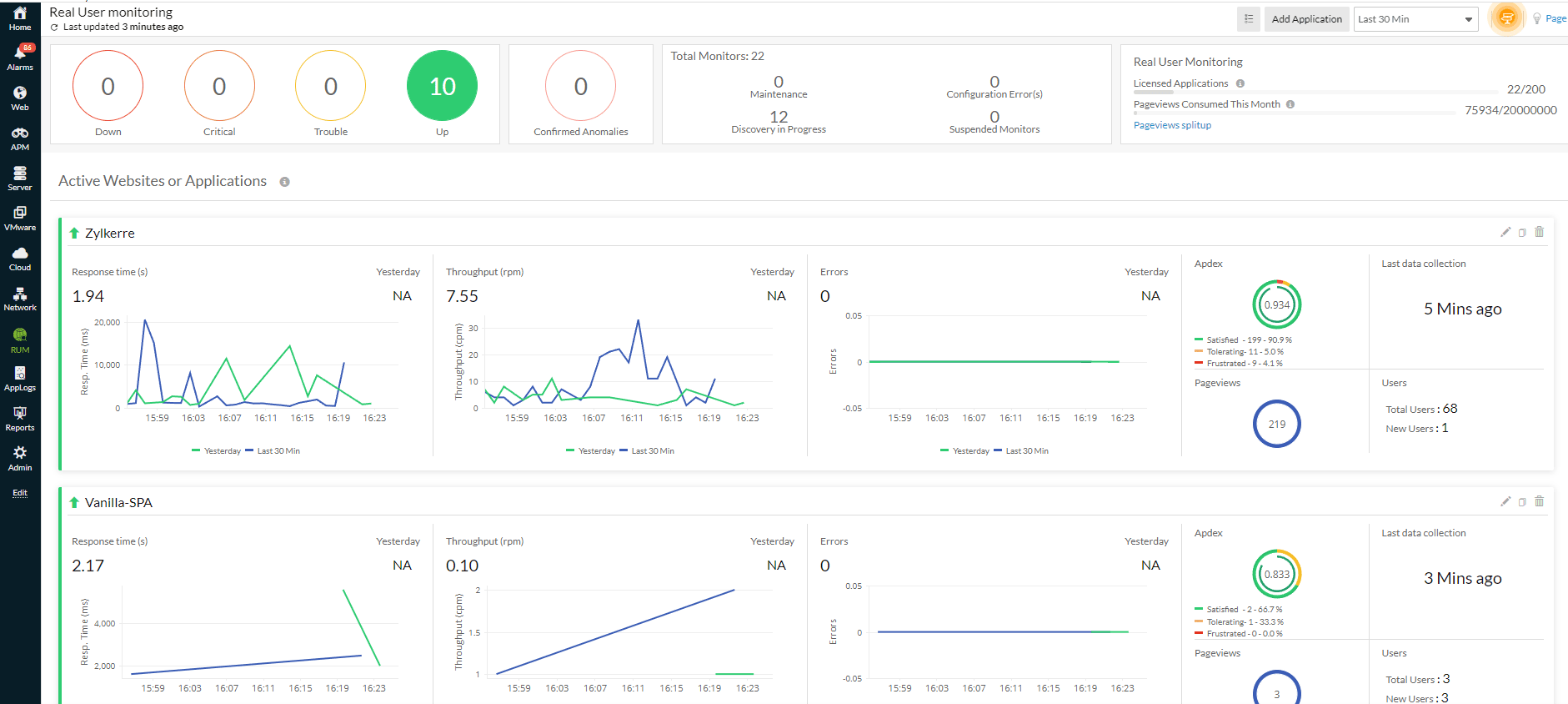
Synthetic monitoring provides controlled baseline measurements by running automated tests from multiple global locations. These tests simulate user requests to reveal consistent performance patterns and identify regional anomalies before they impact real users. Site24x7's synthetic monitoring offers over 130 testing locations, enabling comprehensive geographic coverage for CDN performance validation.
Real User Monitoring (RUM) captures actual user experiences, revealing performance variations across different devices, networks, and geographic locations. RUM data shows how CDNs perform under real-world conditions, including the impact of varying network quality, device capabilities, and user behaviors. This data complements synthetic testing by providing insights into the long tail of user experiences that controlled tests might miss.
Triangulation methodology involves correlating synthetic and RUM data to identify root causes. When RUM shows performance degradation in specific regions while synthetic tests appear normal, it suggests issues with local ISP routing or device-specific problems. Conversely, when synthetic tests fail but RUM data appears healthy, it may indicate testing configuration issues or temporary network problems.
Case study: media streaming service resolves a buffering glitch in particular geography
Zylker Tube, a global media streaming service, experienced increasing user complaints about buffering and quality drops. The complaints were specifically in Southeast Asian markets, despite overall CDN metrics appearing healthy. Users reported that video streams started clearly but quickly became pixelated during evening peak hours.
Challenge: Site24x7's CDN reporting revealed regional performance disparities while cache hit rates appeared normal globally, and specific PoPs in Southeast Asia showed 15% higher latency during peak hours and occasional packet loss spikes. Synthetic monitoring from the affected regions confirmed these findings, showing response times exceeding acceptable thresholds for video streaming.
Approach: RUM analysis provided the missing context: mobile users in the region were disproportionately affected, and the buffering correlated with adaptive bitrate switching failures rather than pure bandwidth limitations. The CDN attempted to maintain high-quality streams but lacked properly configured mobile-optimized encoding profiles for the region.
Solution: The team involved multi-faceted CDN optimization: adjusting cache configurations to prioritize mobile-optimized video segments in affected regions, implementing regional origin servers closer to Southeast Asian PoPs, and reconfiguring adaptive bitrate algorithms for local network conditions. Additionally, the team established regional performance baselines using Site24x7's monitoring to prevent future issues.
Result: The buffering complaints dropped by 78% within two weeks, user engagement in Southeast Asian markets increased by 35%, and the streaming service gained valuable insights into regional optimization strategies. The success demonstrates how CDN-specific reporting combined with comprehensive monitoring can resolve complex regional performance issues.
Debug regional issues with CDN reports
Regional CDN performance issues require sophisticated diagnostic approaches beyond surface-level metrics to understand the complex interplay between network infrastructure, content delivery strategies, and user experiences. Success depends on leveraging comprehensive CDN reporting that combines synthetic monitoring baselines with real user experience data to identify and resolve geographic performance disparities. Partnering with all major CDNs, Site24x7 supports multi-CDN monitoring that helps compare provider performance across regions. For example, if you find CDN A outperforming CDN B in Europe, the difference can be captured in reports to back decisions to switch CDNs. You can also choose Site24x7’s DNS monitoring to gauge the response time of your distributed DNS servers to rule out any lags in that front.
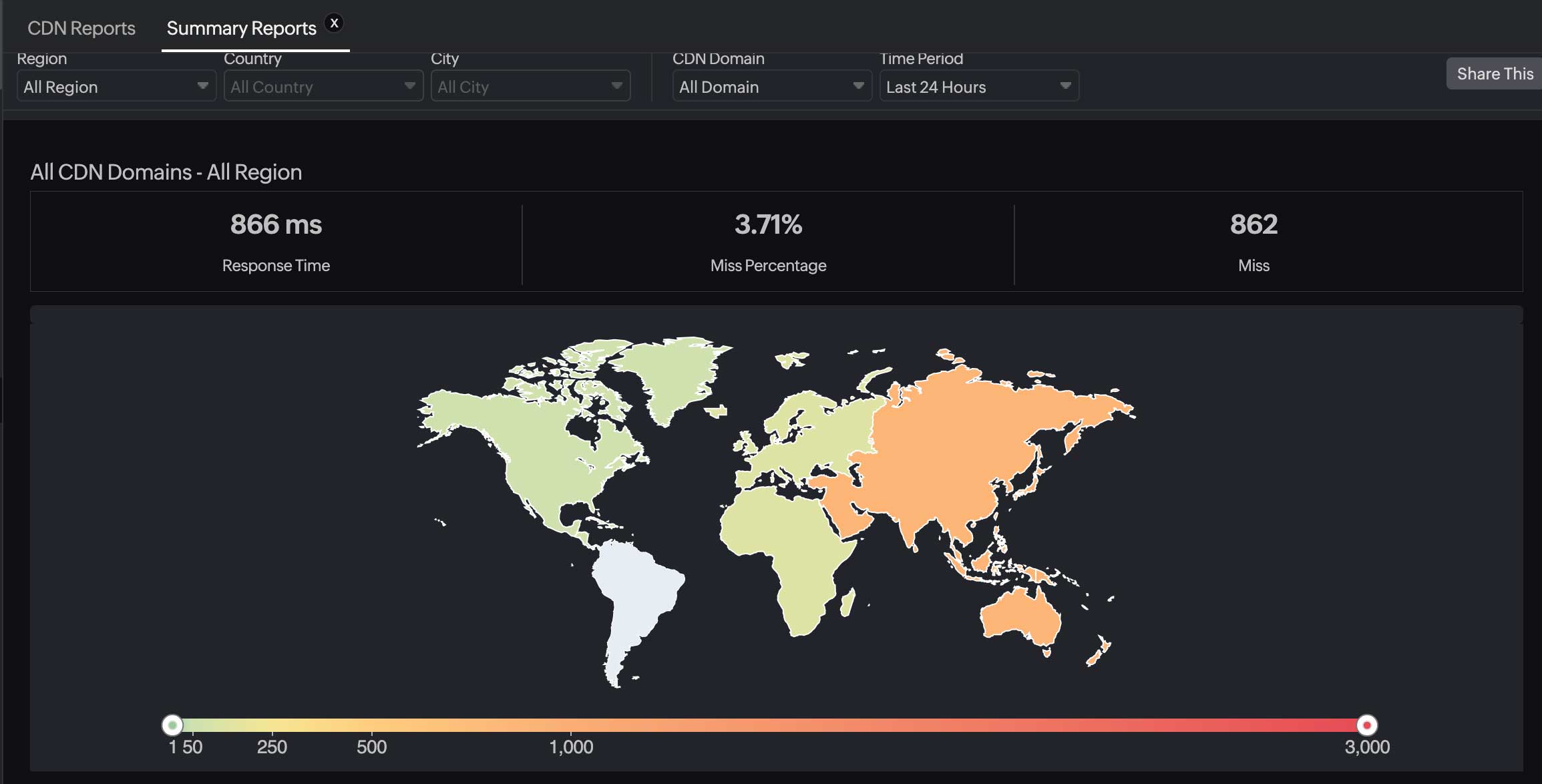
Effective CDN debugging methodology analyzes cache hit ratios and response times per region. This helps isolate origin server bottlenecks through traffic pattern analysis, optimize routing configurations based on network peering relationships, and implement geographic-specific caching strategies. Integrating multiple monitoring perspectives with synthetic testing for consistent baselines and RUM for real-world validation enables accurate triangulation of performance issues.
Proactive regional optimization prevents performance problems by continuously monitoring key metrics segmented by geography, device types, and network conditions. This approach transforms reactive troubleshooting into strategic performance management that anticipates and addresses regional variations before they impact user experiences.
Begin today
Modern CDN management isn't just about global content distribution— it's about ensuring consistent, optimized delivery that adapts to each regional market's unique characteristics and challenges. This regional focus, supported by comprehensive monitoring and reporting capabilities, delivers the reliable performance that global audiences demand. Furthermore, CDN aggregators are platforms that centralize real-time traffic routing, intelligently implemented across multiple CDN providers. This prevents vendor lock-ins and smoothens out performance variations by instantly redirecting user requests through the most viable (faster and cheaper) CDN . CDN monitoring can help companies engage multi-CDNs with insights on regional latency and error rates, report any lags to the aggregators, and demand better performance without outages or slowdowns.
Check out the Site24x7 CDN monitoring page to explore advanced CDN monitoring capabilities including regional performance analysis, synthetic testing from 130+ global locations, comprehensive RUM insights, and integrated reporting tools that provide the essential visibility to debug and optimize CDN performance across all geographic markets.