Global businesses should have their eyes everywhere—wherever their customers are. Only when you ensure consistent uptime across internet service providers (ISPs) and regions can you ensure reliable service availability despite diverse network conditions. Service level agreements (SLAs) are formal commitments defining expected performance metrics, like uptime and response times, holding providers accountable to customers. This solution article talks about the importance of benchmarking SLAs for website uptime across various ISPs and regions with ManageEngine Site24x7’s digital experience monitoring. Discover what SLA, SLO, and SLI mean in this context, how to benchmark them, and the best practices to ensure adherence along with a case study on how a consumer bank achieved a reliable 24/7 digital experience for its international customers by achieving 99.97% uptime.
Monitoring a website’s consistency in uptime, performance, and security is essential. Beyond monitoring, it is also essential to set and chase acceptable targets as benchmarks for diverse ISPs and regions to deliver reliable service despite all the uncertainties of the network. In IT operations, SLAs, SLOs, and SLIs are those benchmarks. SLAs formalize these commitments, specifying performance metrics such as uptime and response times to hold providers accountable to customers.
Here are the key terms and their definitions: An SLA is the promise made to customers, outlining guaranteed performance levels; a service level objective (SLO) is an internal target set to achieve or exceed the SLA; and a service level indicator (SLI) is the measurable data used to verify compliance. Customer trust depends on availability, and even a few minutes of downtime can result in millions of dollars in lost transactions, reputational damage, and SLA penalties, making this approach non-negotiable for global enterprises like banks, e-commerce platforms, and SaaS providers.
Learn how IT operations can use the website monitoring features available on ManageEngine Site24x7, a robust digital experience monitoring platform, to benchmark website uptime across ISPs and regions, ensuring stringent SLA targets are met. Further, by integrating synthetic and real user monitoring (RUM) available on Site24x7 along with deep application performance and network insights, you can empower teams with the insights to validate performance proactively, detect issues early, and maintain service reliability with confidence.
Understanding SLA, SLO, and SLIs as website performance benchmarks
Benchmarking website uptime begins with a clear grasp of SLAs, SLOs, and SLIs, and let’s see them in detail.
An SLA represents the formal commitment to customers, such as promising 99.97% website uptime per quarter. The SLO, an internal goal, might aim for 99.98% uptime to provide a buffer to ensure the SLA is consistently met, serving as a strategic lever for IT teams. The SLI, the quantifiable metric, is the actual website uptime percentage calculated to validate compliance, such as the percentage of time the site is accessible over a month.
These elements are interconnected: SLIs supply the raw data, SLOs set the performance thresholds, and SLAs are validated through benchmarking against these commitments. For IT leaders, this framework ensures that uptime goals are not only defined but also measurable and achievable across diverse network environments.
Why benchmarking across ISPs and regions is critical
Relying on uptime monitoring from a single location or ISP is inadequate for global operations. Customers connect through a variety of providers, networks, and geographic regions, creating potential blind spots that benchmarking addresses. Regional variability can lead to stark performance differences. In some cases, a website may perform well in Europe, but could falter in South Asia due to local infrastructure challenges. ISP discrepancies, such as packet loss on one provider while another remains stable, further complicate reliability.
For industries like banking, insurance, and healthcare, regulatory and contractual obligations impose strict penalties for SLA breaches, necessitating comprehensive validation. These benchmarks matter for e-commerce, too, as their very existence hinges on the portals always being available for the shopper, especially during sale events. Moreover, customer experience suffers when users encounter slow or unavailable services, regardless of the underlying cause. Benchmarking, therefore, involves collecting availability data across ISPs and regions, comparing it against established baselines or standards, and reporting compliance to uphold SLAs effectively.
ManageEngine Site24x7: the digital experience monitoring platform for SLA validation
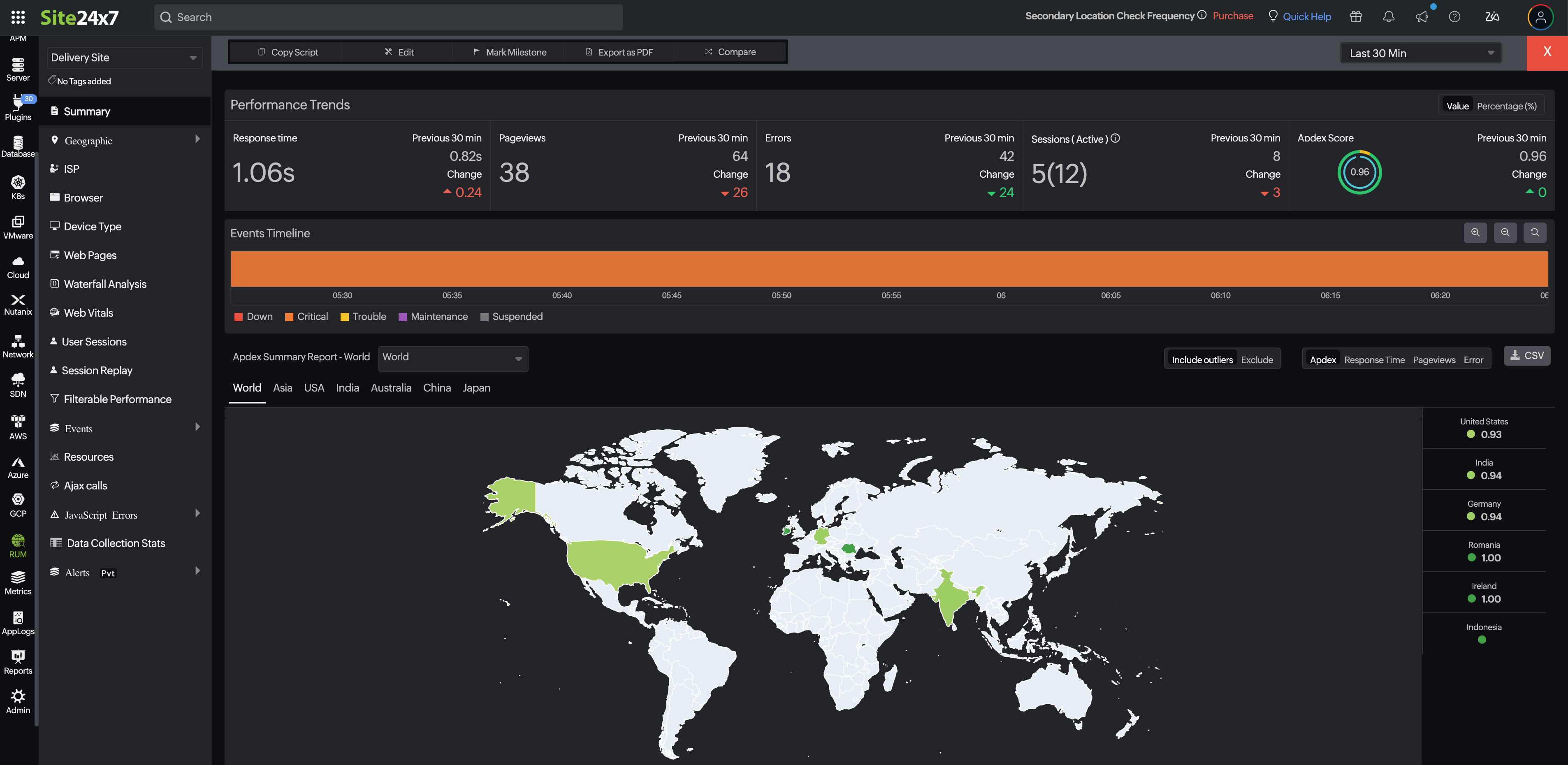
ManageEngine Site24x7 is designed to support IT teams in validating SLAs with its suite of advanced monitoring capabilities. Its synthetic monitoring feature has over 130 monitoring locations (point of presence probes), allowing teams to test website availability and latency from specific regions tailored to user bases. This controlled environment validates uptime against a stringent target like, say, 99.97% SLA by simulating user interactions under diverse conditions, providing a consistent baseline for performance assessment.
The platform’s RUM tool complements your operations by capturing actual end-user sessions, offering a granular breakdown of performance metrics by ISP, geography, device type, and browser. This data uncovers the exact ISPs that under-perform, and pinpoints providers who suffered latency spikes in particular regions, such as Southeast Asia. Once these details are in, operations can cut to the chase to execute targeted troubleshooting activities. ISP performance analysis leverages RUM to enable per-ISP benchmarking, while synthetic monitoring provides controlled baselines to cross-validate findings, ensuring a holistic view of network health.
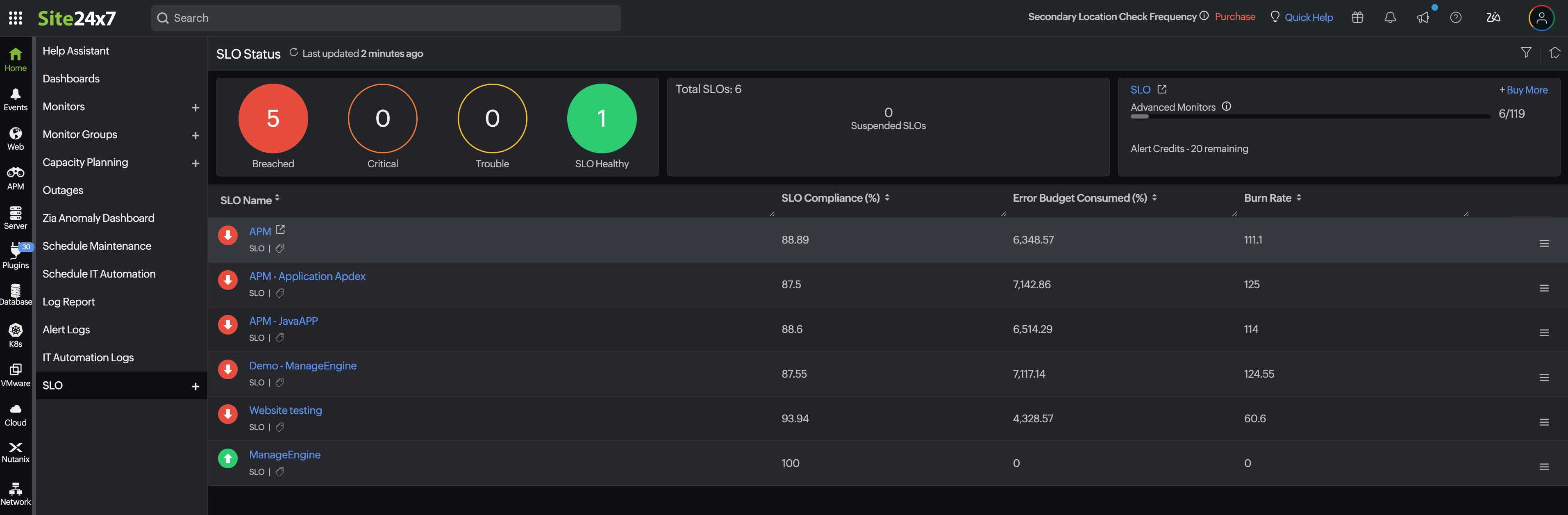
Site24x7 offers customizable SLA and SLO reports, generating alerts when thresholds are breached, and provides composite views that integrate availability, latency, and error rates. Proactive diagnostics, powered by AIOps, perform root cause analysis for outages, group alerts to reduce noise, and integrate with ITSM tools for automated ticketing, streamlining incident management and enhancing SLA adherence.
Case study: Zylker Bank Pvt. Ltd.
Zylker Bank Pvt. Ltd is a consumer retail bank operating across the US region. The bank processes millions of daily transactions against stringent performance demands. Its SLA with customers mandates 99.97% website uptime per quarter, which is echoed by regulatory requirements for near real-time outage reporting and customer expectations for secure, fast, always-on service. The bank encountered a challenge when it noticed that, though its overall uptime appeared high, customers on certain ISPs in North America reported frequent outages.
To address this, the bank’s operations team configured synthetic monitoring with Site24x7, setting up probes from over 20 global locations to collect availability data every minute and establish a response time baseline of less than 150ms and an uptime baseline of over 99.97%. Further, RUM insights provided data on segmented user traffic per ISP, leading to the big revelation that a certain ISP in the eastern US exhibited 3% higher latency than the baseline. The bank compared its performance against competitors using openly accessible benchmarking reports and online forums, and identified it as a specific bottleneck.
By configuring regional and ISP-specific SLA reports with auto-escalations for stringent breaches, and by creating executive dashboards for the CIO and compliance teams, Zylker Bank narrowed down on ISP issues, escalated them to providers, and got them rectified to maintain SLA compliance across all regions. This monitoring-data-led approach eliminated downtime-related penalties within two quarters. This case exemplifies how benchmarking, beyond mere monitoring, compares performance against SLA targets to ensure actionable outcomes.
Framework for benchmarking website uptime across ISPs and regions
To implement effective benchmarking, follow this structured approach using Site24x7:
- Define SLIs, SLOs, and SLA targets: Establish SLIs such as website uptime percentage, SLOs like 99.98% uptime as an internal goal, and the SLA at 99.97% uptime per quarter as the customer commitment.
- Collect metrics: Configure synthetic monitoring across global probes to gather availability data and set up RUM to capture ISP-specific performance breakdowns.
- Analyze variations: Compare performance ISP-to-ISP (e.g., ISP-A vs. ISP-B) and region-to-region (e.g., Asia vs. Europe), benchmarking against industry standards like 99.9% uptime for financial sectors.
- Set baselines and compare: Use historical data to establish pre- and post-change baselines, incorporate competitor or industry reports where available, and align with internal performance goals.
- Report and validate: Generate SLA compliance reports in Site24x7, create executive dashboards, and set automated alerts for SLA deviations to ensure ongoing validation.
- Improve continuously: Escalate ISP issues to providers, optimize content delivery network (CDN) or routing strategies, and adjust internal SLOs to refine performance over time.
Best practices
Adopting best practices enhances the effectiveness of benchmarking with Site24x7:
Merge insights from both synthetic and RUM monitoring to achieve comprehensive visibility, combining controlled test data with real-world user experiences for a complete picture of performance.
Select monitoring locations that align with your actual user distribution, like prioritizing Southeast Asia probes if 40% of users are based there to ensure relevant data collection.
Compare ISP-level performance before escalating to application-level issues, isolating network-related problems like packet loss to avoid misdiagnosis.
Align internal SLOs closely with SLAs, setting a 99.98% uptime target to provide a buffer against minor fluctuations, ensuring the 99.97% SLA is consistently met.
Conduct quarterly reviews of SLA reports in collaboration with compliance and business teams, using Site24x7’s executive dashboards to align technical performance with strategic goals.
Train IT staff regularly on configuring and interpreting Site24x7’s monitoring tools, ensuring proficiency in setting thresholds and analyzing RUM data.
Perform periodic stress tests or mock outage scenarios to validate the robustness of your benchmarking setup, adjusting probe frequencies or alert rules as needed.
Integrate Site24x7 with existing ITSM systems to automate incident workflows, reducing mean time to resolve (MTTR) and enhancing response efficiency.
KPIs
Track these key performance indicators (KPIs) to measure benchmarking success:
- Availability percentage per region and ISP, targeting 99.98% uptime.
- Latency percentiles (p90, p95) to assess response time distribution, aiming for under 150ms.
- Error rates per transaction type, keeping 5xx errors below 1%.
- MTTR for ISP-related issues, striving for under 15 minutes.
- SLA compliance rate, ensuring 100% of quarterly periods meet the 99.97% uptime target.
Try Site24x7
Benchmarking website uptime across ISPs and regions is not a luxury but a necessity for SLA validation, especially for business-critical websites where maintaining 99.97% uptime per quarter is critical to avoid penalties and preserve customer trust. By configuring ISP latency check monitoring, setting precise SLOs and SLAs, and leveraging Site24x7’s reporting and diagnostic tools, IT teams can proactively manage performance and ensure reliability.
Though you cannot control the Internet, you can place checks and measures to ensure your websites perform well and are provided with backups to ensure uninterrupted services your customers deserve. This proactive approach mitigates the risks of internet unpredictability, delivering a consistent digital experience globally. Explore ManageEngine Site24x7’s digital experience monitoring capabilities and sign up for a 30-day, free trial.